Pre-launch

Set a price floor on your position.

Hedgd is downside insurance for a crypto trade. You pick the lowest price you're willing to accept, pay a premium upfront, and if the market falls below that price you're paid the difference. Your position is never touched — no liquidation, no margin call, no stop-loss that fires on a wick.

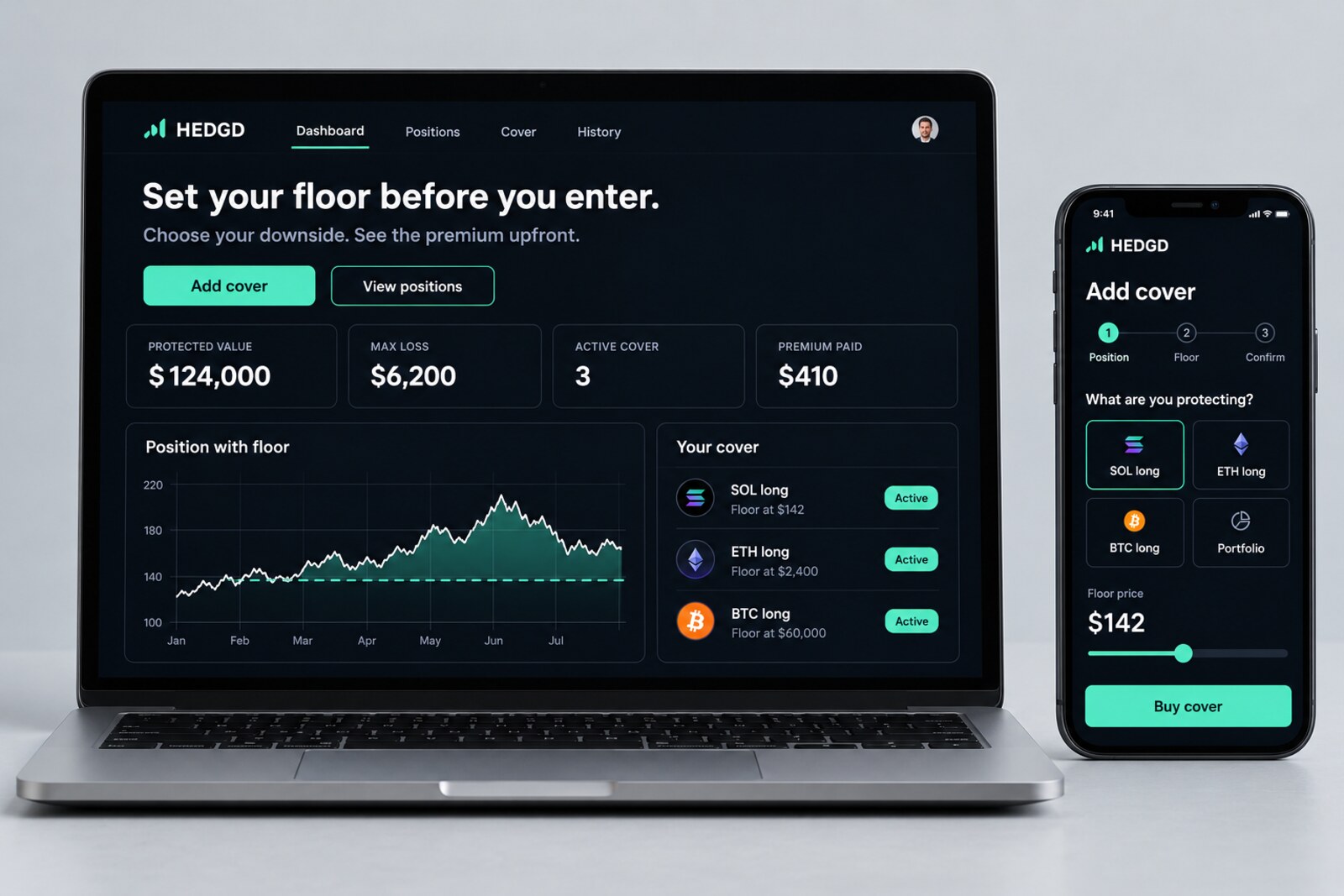
Hedgd dashboard showing a price line with a protective floor beneath it, and a mobile screen for adding cover

One trade, with and without a floor.

You hold 100 SOL bought at $150. You set a floor at $130 for 30 days. The premium is $220. Here is what happens at expiry, at three different prices.

SOL at expiry Position alone With a $130 floor Difference
$95 −$5,500 −$2,220 +$3,280
$130 −$2,000 −$2,220 −$220
$190 +$4,000 +$3,780 −$220

The premium is the whole cost, paid once, known before you commit. Above your floor it is the only thing you lose — your upside is untouched. Below it, the payout covers the gap.
Illustrative numbers. Hedgd has not launched and no live pricing exists yet.

Three steps, before you enter the trade.

Cover is bought at the moment you open a position, not bolted on after it has already moved against you.

01

Pick the position

Choose what you're protecting — a spot holding, a long, or your whole portfolio. Hedgd reads the size from your wallet.

02

Set the floor

Drag to the lowest price you'd accept. The premium updates as you move it, so you see the exact cost before agreeing to anything.

03

Pay once, then forget it

One transaction. If price closes below your floor at expiry, the payout settles to your wallet automatically. If not, nothing happens.

A stop-loss sells your bag. A floor doesn't.

Every trader has been stopped out on a wick — the price dips for ninety seconds, your stop fires, you're in cash, and the chart recovers without you. The tool designed to limit your loss took your position away at the worst possible moment.

Perps let you hedge, but you're then running a second leveraged position that needs margin, can be liquidated, and demands attention at 3am. You've solved one risk by adding another.

A floor is neither. It's a contract that pays you if price ends below a level you chose. Your coins stay in your wallet the entire time. The worst case is known the moment you buy, and it's the premium.

Your position is never touched Hedgd holds no custody of your assets. Cover is a separate contract that settles in cash.

No margin, no liquidation There is nothing to top up and nothing to be forced out of. You cannot lose more than the premium.

Price comes from an oracle Settlement reads a published price feed at expiry. No discretion, no claims process, no one to argue with.

Status Pre-launch, in testing with a small group. No token has been issued.

What it costs, and what you actually own.

How is the premium calculated?
By distance and time. A floor far below the current price over a short window is cheap; a floor just under spot for three months is expensive. You always see the number before you commit.
What does Hedgd take?
A flat fee inside the premium — no subscription, no fee on payout, nothing charged when your cover expires unused.
What am I actually buying?
A contract that pays the difference between your floor and the settlement price, for the size you covered. Functionally a put option, priced and settled onchain.
Can I sell the cover early?
At launch, no — cover runs to expiry. Secondary transfer is the first thing on the roadmap after launch.
What if the price recovers after dipping below my floor?
Settlement reads the price at expiry, not the lowest point along the way. A dip that recovers pays nothing — which is exactly the wick that would have stopped you out.
Do I need to do anything at expiry?
No. If you're owed a payout it settles to your wallet on its own.
Which assets are supported?
BTC, ETH and SOL at launch. Assets with a reliable price feed and real liquidity come next.
Is this insurance in the legal sense?
No. It is an onchain derivative contract, not a regulated insurance product, and there is no insurer standing behind it. We use the word because it describes the shape — you should know what it isn't.

Know your worst case before you enter.

Early access opens to a small group of traders first. Tell us what you trade and how you currently manage downside.

Request early access